Guides · 2026–27 tax year
Published
What Is Bed and ISA, and Do You Pay Capital Gains Tax on It?
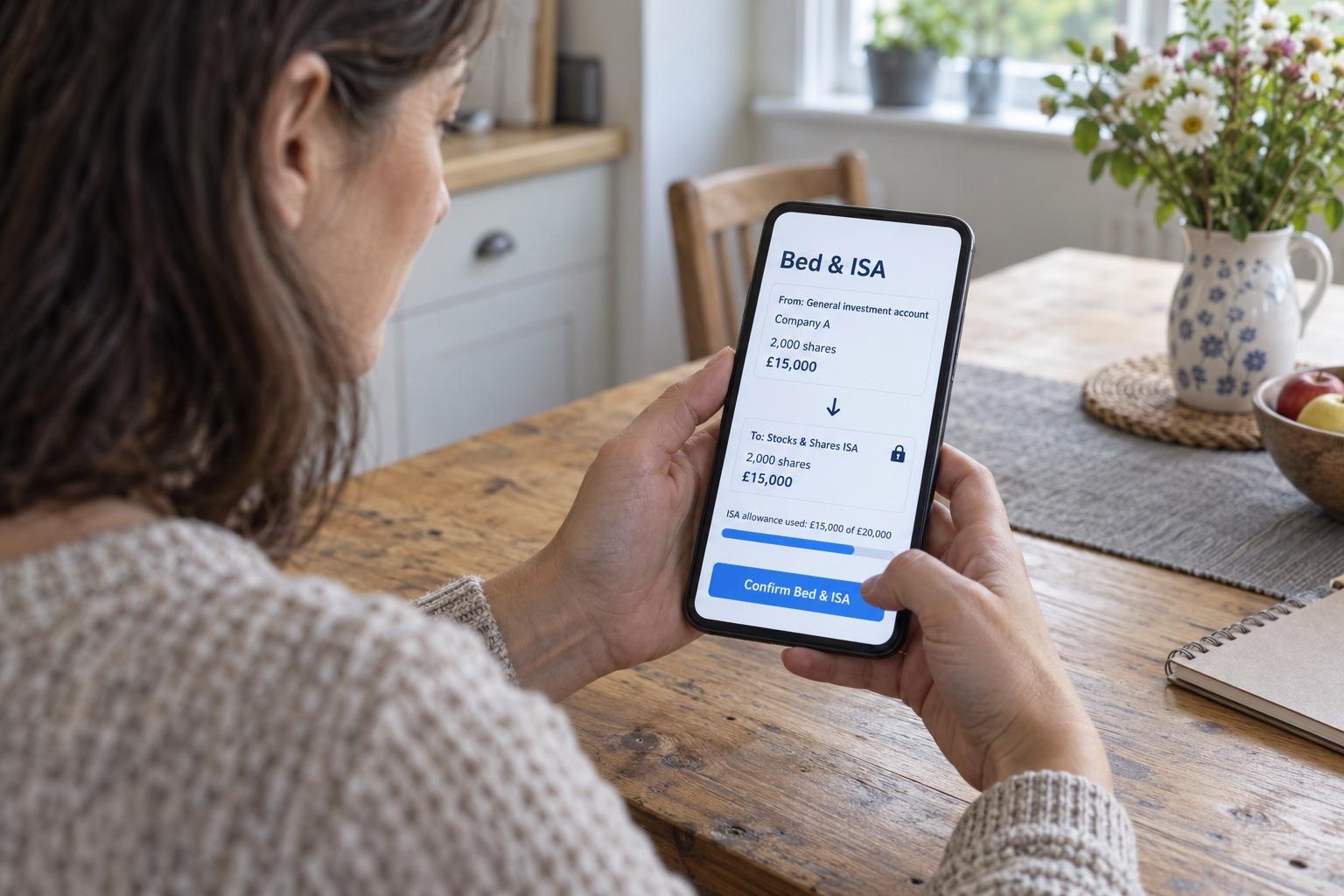
You hold shares in an ordinary account and want them inside your Stocks and Shares ISA. The usual way to get them there is to sell them and buy them back inside the ISA. How does HMRC tax that?
The short answer
- In a Bed and ISA, the sale in your ordinary account counts for Capital Gains Tax, with the gain worked out from your average cost. The same-day and 30-day rules don't match the ISA purchase with your sale, because ISA shares are a separate holding.
- A Bed and ISA gain shares the £3,000* allowance with your other gains. Selling part of a holding can keep the gain inside it.
- A Bed and ISA sale at a loss gives you a normal capital loss, but losses on shares once they're in the ISA can't be used.
- After a Bed and ISA, gains in the ISA are free of Capital Gains Tax, but the buy-back uses ISA allowance and can cost 0.5% stamp duty.
* Correct at the time of writing. Rates and allowances can change, so check HMRC's current Capital Gains Tax rates and tax-free allowance on GOV.UK.
The sale is taxed like any other sale
Bed and ISA is two trades. You sell shares in your ordinary account, sometimes called a general investment account, and buy the same shares in your Stocks and Shares ISA with the money. It's done this way because the rules don't let you transfer the shares themselves into an ISA, unless they came from an employee share scheme. They have to go in as cash.
The sale is a normal disposal, the tax word for selling or giving away an asset. Shares outside an ISA or pension are chargeable, meaning gains on them can be taxed, so the gain counts for Capital Gains Tax in the tax year you sell. The fact that you buy the shares straight back, just in a different account, makes no difference to the sale.
Your gain is the sale proceeds minus what the shares cost you. You can take off dealing fees on the purchase and the sale, and any stamp duty you paid when you bought. If you bought the shares at different times, the cost is your section 104 average cost: HMRC pools all your shares in a company and uses the average price.
The gain joins your other gains for the year. Together they're taxed only above the £3,000* allowance, at 18%* within your basic rate band and 24%* above it. Our guide to how Capital Gains Tax works explains the rates.
* Correct at the time of writing. Rates and allowances can change, so check HMRC's current Capital Gains Tax rates and tax-free allowance on GOV.UK.
Why the 30-day rule doesn't catch the ISA purchase
Normally, if you sell shares and buy the same ones back within 30 days, the 30-day rule matches your sale with the new purchase. Your older shares are left out of it. A buy-back on the same day falls under the same-day rule instead, with the same effect. Either way, the gain you meant to bank mostly disappears.
Both rules only match shares bought by the same person in the same capacity, which means holding them in the same way, such as in the same kind of account. The ISA regulations treat shares in an ISA as held in a different capacity from all your other shares, for every pooling and matching rule. So the ISA purchase is never matched with your sale, whether you buy back the same minute or the next week. The sale is matched with the shares in your ordinary account, and the gain stands.
So the sale uses your allowance on gains that have built up, and any later gains and income on the shares aren't taxed. Losses in the ISA can't be used either, and the move has costs, covered below.
Example: moving a whole holding
Say you bought 1,200 shares in Company A at £4 in 2021 and another 800 at £6 in 2023. Your pool is 2,000 shares costing £9,600, an average of £4.80 a share. In November 2026 the price is £7.50, and you move the whole holding into your ISA. Fees are left out to keep the sums simple. The tax depends on your income, so the example shows it for a higher rate taxpayer and for a basic rate taxpayer.
Selling 2,000 shares at £7.50
- Sale in your ordinary account
- £15,000
- Pooled cost of 2,000 shares
- −£9,600
- Gain
- £5,400
- Tax-free allowance
- −£3,000*
- Taxable gain
- £2,400
- Tax at 24%* (higher rate taxpayer)
- £576
- Tax at 18%* (basic rate taxpayer, if the gain fits in your basic rate band)
- £432
If you have no other gains in the tax year. The £15,000 buy-back uses £15,000 of your £20,000* ISA allowance for the year.
* Correct at the time of writing. Rates and allowances can change, so check HMRC's current Capital Gains Tax rates and tax-free allowance on GOV.UK.
You'd pay the tax through Self Assessment by 31 January 2028, and the shares sit in your ISA from then on.
Those are the two ends. The tax lands between them if the gain pushes you over the top of the basic rate band. Your taxable gain is added on top of your taxable income. The part that fits inside the band is taxed at 18%*, and anything above the top of the band is taxed at 24%*.
Say your taxable income is £36,700, which leaves £1,000 of the £37,700* basic rate band. The same £2,400 taxable gain is split in two.
The same sale with £1,000 of the basic rate band left
- Taxable gain
- £2,400
- Inside the band: £1,000 at 18%*
- £180
- Above the band: £1,400 at 24%*
- £336
- Total tax
- £516
If you have no other gains in the tax year. The more of the band your income has already used, the more of the gain is taxed at 24%*.
* Correct at the time of writing. Rates and allowances can change, so check HMRC's current Capital Gains Tax rates and tax-free allowance on GOV.UK.
Selling just enough to stay within the allowance
You don't have to move everything in one go. Selling part of the holding in each tax year can keep each year's gain inside the allowance, so there's no tax to pay. The cost of a part sale is a share of the pool. It's the pooled cost times the shares you sell, divided by the shares in the pool, as HS284 sets out.
To find how many shares fit, work out the gain on one share and divide the allowance by it. In the example, each share is worth £7.50 and has an average cost of £4.80, so each one sold makes a gain of £2.70. Then £3,000* divided by £2.70 is 1,111 shares, rounding down.
Selling 1,111 of the 2,000 shares at £7.50
- Sale in your ordinary account
- £8,332.50
- Cost: £9,600 × 1,111 ÷ 2,000
- −£5,332.80
- Gain, inside the £3,000* allowance
- £2,999.70
If you have no other gains in the tax year. The other 889 shares stay in the pool at a cost of £4,267.20, the same £4.80 average.
* Correct at the time of writing. Rates and allowances can change, so check HMRC's current Capital Gains Tax rates and tax-free allowance on GOV.UK.
A few things change the number. Dealing fees reduce the gain slightly, so they give you a little more room. Any other gains in the same tax year use the allowance first, so a sale elsewhere leaves fewer shares to move. And the price on the day you sell is the one that counts. If it rises between your sums and the trade, the gain rises with it.
The trade-off is time. The shares you leave behind stay outside the ISA, where their dividends and later gains are taxable, until you move them in a later year.
If the shares are worth less than you paid
At a loss, a Bed and ISA gives you a normal capital loss you can use. Because the ISA purchase isn't matched with the sale, nothing cancels it. You can set it against other gains in the same tax year, or carry it forward if you have none. You have to claim it within 4 years of the end of the tax year. Our guide to capital losses on shares covers how.
500 shares bought for £5,000, now worth £3,500
- Sold and bought back in your ISA: loss on the sale
- −£1,500
- Sold and bought back the same day in your ordinary account
- £0
Bought back in the ordinary account, the sale is matched with the new purchase, so there's no loss. The 500 shares keep their £5,000 cost.
Losses on the shares once they're in the ISA don't count. Gains in an ISA aren't chargeable, so losses there aren't allowable either. If the shares fall further after the buy-back, that loss can't be set against anything.
What it costs
Moving shares this way isn't free, and the costs come on top of any tax.
- Stamp Duty Reserve Tax of 0.5% when you buy UK company shares electronically. Buying back £15,000 of shares costs £75. You don't normally pay it on foreign shares bought outside the UK, or on units in a unit trust or open-ended fund bought from the fund manager.
- Dealing fees on the sale and on the purchase, if your provider charges them.
- The spread, the gap between the price you sell at and the price you buy at, and any price movement if the two trades don't happen at once. You may end up with slightly fewer shares in the ISA than you sold. Between the two trades you don't hold the shares, so a price rise in that time isn't yours.
- ISA allowance. The money you pay in counts towards the £20,000* a year limit, so a Bed and ISA leaves less room for new savings that tax year.
- Tax paid sooner. If the gain is over the allowance, you pay tax now on a gain you might otherwise have left for a later year, or never realised.
* Correct at the time of writing. Rates and allowances can change, so check HMRC's current Capital Gains Tax rates and tax-free allowance on GOV.UK.
Reporting the sale
A Bed and ISA sale is reported like any other share sale. You need to report it if your gains for the year are over the allowance. If you're registered for Self Assessment, you also report it if you sold more than £50,000 of chargeable assets in the tax year, even with no gain. Moving a large holding can cross that line on its own.
Our SA108 guide shows which boxes to fill in. If you're moving a large holding with big gains, or the shares came from an employee share scheme, a tax adviser can check the figures before you trade.
How our calculator handles it
Our calculator works out the gain on the sale from your ordinary account. Paste in that account's trades and the sale, but not the ISA purchase, because it belongs to a separate holding. If you add the ISA purchase as if it were in the same account, the calculator will match it under the 30-day rule and show the gain as almost nothing.
Work out your own CGT
Paste your trades from your broker and see your gain, allowance and tax in seconds.
Open the calculator →Sources on GOV.UK: Individual Savings Accounts: how ISAs work, HS284 Shares and Capital Gains Tax, Capital Gains Tax: work out if you need to pay. Last checked 5 October 2026.
This is an estimate, not financial or tax advice. It may contain mistakes and does not cover every situation, so check your figures with HMRC or a qualified adviser before you rely on them.